

 Presidential debates have been yet another issue in a race that has divided the nation. Though candidates for chief executive have debated each other since 1960, one of the most famous debates in American history was not even for the top spot.
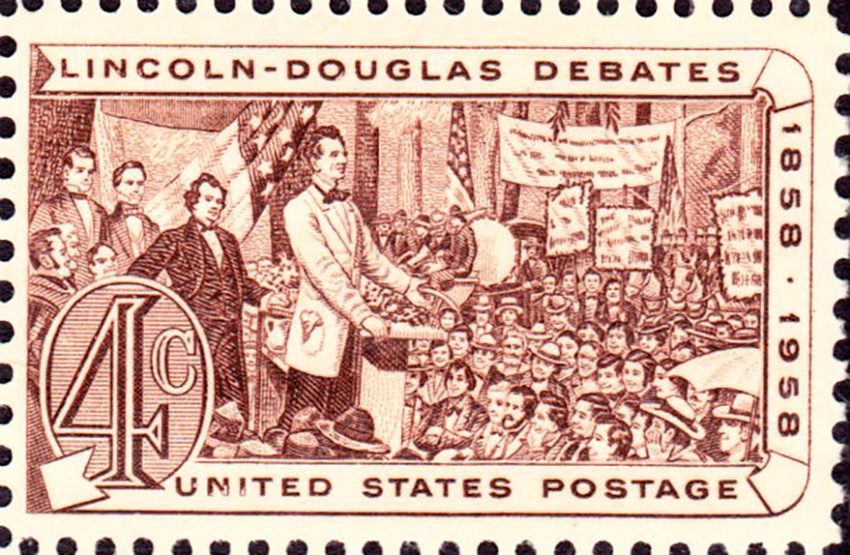
In 1858, Abraham Lincoln and Stephen A. Douglas met in a series of seven debates across Illinois for a seat in the U.S. Senate. The debates elevated the state into the national spotlight, and raised many of the issues that defined the 1860 presidential election which pitted the same two candidates against each other.
Douglas, a two-term U.S. Senator who had shepherded the bill to establish the Illinois Central Railroad, was a nationally known figure whose racial views are often blasted today. Douglas supported the Dred Scott decision, and was a champion of “popular sovereignty,” allowing territories the right to decide on slavery themselves.
The ambitious Lincoln desired the seat, critical of the incumbent’s views on the extension of slavery. A spirited battle ensued, and Douglas delivered some
130 addresses during the campaign, while Lincoln spoke formally at least 63 times.
The most famous address from Lincoln was his “House Divided” speech, condemning the national slavery division, during his nomination at the Republican convention in Springfield on June 16.
In all, Douglas traveled 5,227 miles in the hundred days before the November election, while Lincoln wound his way across 4,350 miles from July to November.
Hamstrung by a lack of funding compared to Douglas’ free spending, and seeking to neutralize his opponent’s momentum, Lincoln sometimes appeared in cities on the same day as Douglas. On June 24, Lincoln challenged Douglas to a string of debates “to divide time, and address the same audiences during the present canvass.”
The offer put Douglas at a disadvantage. Not only would Douglas be forced to share the stage with his opponent, but Lincoln was more adept in such a format. Douglas risked scorn if he backed down from the offer, though, and he finally accepted.
Seven debates were set between August 21 and October 15, and Douglas chose the dates and sites; in order, they were Ottawa, Freeport, Jonesboro, Charleston, Galesburg, Quincy, and Alton. Each debate featured a one-hour opening speech, a 90-minute answer, and a half-hour rebuttal by the first speaker.
Though many in the East still considered Illinois part of the frontier, Lincoln and Douglas’ differing views on slavery attracted national attention. The New York Times called Illinois “the most interesting political battleground in the Union.”
For the first time, correspondents telegraphed daily news of the campaign. Lincoln scholar David Herbert Donald wrote the campaign was “a choice between two fundamentally opposed views of the American experience.”
The excitement in many debate towns was enormous, and often featured parades and bands. In Ottawa, some 10,000-12,000 people were on hand, standing all the while as there were no bleachers or seats. Many trains offered special rates to Ottawa, where reporters, unable to find rooms, slept on couches.
A crowd of 15,000 stood in a cold wind in Galesburg, while in Charleston and many campaign cities, onlookers were treated to floats featuring 32 young ladies – one for each state of the Union.
The two men struck an unusual picture. Nearly a foot shorter than his opponent, Douglas’ head barely reached Lincoln’s shoulders.
The polished Douglas was often resplendent in fine suits, and traveled in elegant rail cars. The shrewd Lincoln wore his usual clothes, appeared ungainly and awkward, and rode in regular passenger cars, helping him connect with voters.
Both men, in the words of Donald, “exaggerated their differences” on slavery, and the campaign had clear racial overtones. In Charleston, crowd signs mocking interracial marriage were visible, and both candidates, at one time or another, stated their beliefs that the races were not equal.
Many believe Lincoln actually won the debates, since he held his own, and Douglas never adequately expressed the difference between popular sovereignty and his personal views on slavery.
Though Republicans held an edge at the polls in November, it was not enough to affect the apportionment of the legislature, which elected U.S. Senators in Illinois until 1913. Douglas prevailed in the assembly, 54-46.
Dejected at the loss, Lincoln wrote “I now sink out of view, and shall be forgotten.” The coming years proved the irony of those words.
Tom Emery is a freelance writer and historical researcher from Carlinville, Ill. He may be reached at (217) 710-8392 or ilcivilwar@yahoo.com.