
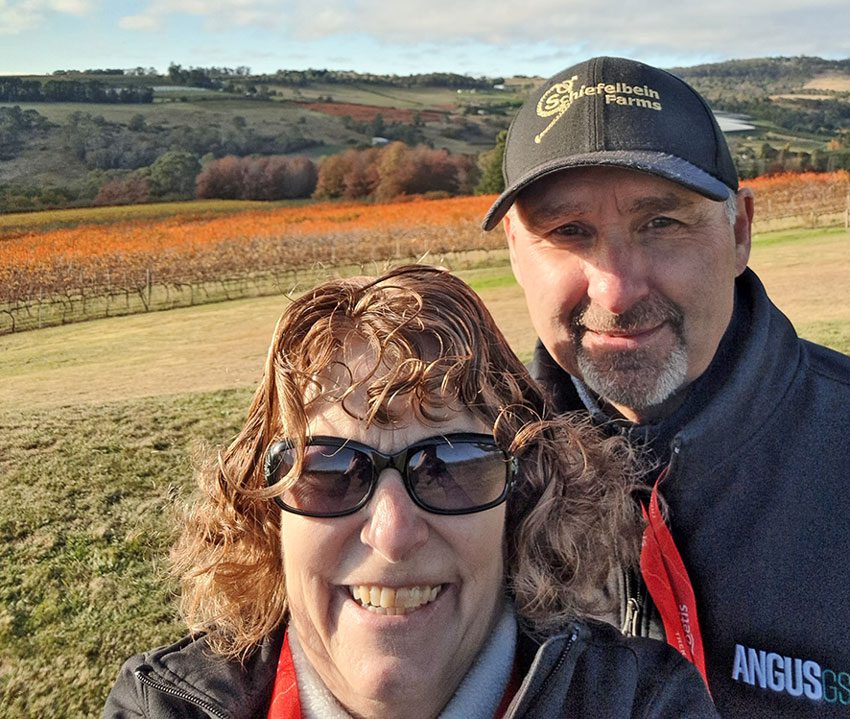

 During their recent visit Down Under, to Australia, husband and wife Donnie and Jennifer Schiefelbein saw many kangaroos, like deer here according to the local Australians they met, and many sheep. On their tour, they toured Sydney, which they referred to as a “gorgeous” city, and Brisbane, and had the opportunity to see much of the Australian back country. What Donnie will remember most though is the people he met.
“People are people are people, and it’s just amazing,” Donnie said. “You travel halfway around the world, and when you get right down to it, they’re doing the best they can.”
They visited Australia for two weeks as part of the Neogen World Angus Forum held in Brisbane on May 7 and 8, an event held every four years in different places.
Schiefelbein Farms
Two individuals from the Twin Cities, Frank and Frosty Schiefelbein started the farm located outside Kimball in 1955. According to their website, schiefelbeinfarms.com, they have kept this a family operation, one that has grown to become the largest Registered Angus operation in the state and the 30th largest seed stock operation across all breeds.
“My dad came from Minnea-polis/Saint Paul, with my mother and one child in tow, and just decided he was going to go from being a city boy to being a farmer,” Donnie said. “And so he started with just that initial lake home on Lake Betsy. … It all just kept growing. He kept growing the farm as he kept growing the children.”
Seven of Frank and Frosty’s nine sons, including Donnie, work on the farm full-time to this day. Frank and Frosty’s family has grown to 32 grandchildren and 36 great-grandchildren.
“[We] just keep having to expand with the number of mouths we have to feed,” Donnie said.
Today, the farm includes 1,100 calves and 2,500 steers – the -latter ones ready to be harvested to become beef.
World Angus Forum
Donnie and Jennifer Schiefelbein took this all-expenses-paid trip to the Neogen World Angus Forum for the first time.
He was a past president of the American Angus Association, the largest cattle breed association in the country and a parent company to an organization called Certified Angus Beef, according to Donnie.
Neogen, Schiefelbein Farm’s genetic testing company, asked Donnie to represent them at this event. The sponsors of this event, Neogen chose a couple of different American people to represent them. Both Donnie and Jennifer thought this was a pretty cool opportunity.
“That’s nice,” Donnie said of the trip. “Free to Australia for, what was it, 10 days? Longer, two weeks. Jennifer got to come with me. Of course I wouldn’t have gone without her.”
“I wouldn’t let him [go] without me,” Jennifer said with a laugh.
This forum event, Donnie explained, is a way for Angus associations and all those with Angus cattle to meet and talk about concerns they have, the direction they want to take the breed, and how to position the breed for long-term success.
“As you know, anytime you get a group together,” Donnie said, “it also allows relationships to build.”
During this forum they talked about placing all their Angus cattle data, including many traits, such as carcass, weaning and yearly weights, into a world evaluation database.
“It doesn’t matter if you’re in Australia or United States or Timbuktu, you can compare animals, and you can say which are the best ones genetically for a whole host of traits, and we’ve already done that to some extent,” Donnie said. “So there’s a mini world evaluation, but it’s only like two or three traits, and they’re trying to expand it to much more.”
Jennifer added, “Just trying to get all of the countries to work together to move the Angus breed forward.”
The Angus breed, Donnie discovered while visiting with others, is the dominant breed across the globe.
“Backwards up to 1955 when [our family] had started … we were just [a] fractional amount of the breed,” Donnie said. “It’s just basically taken over the whole landscape of the beef industry.”
The next World Angus Forum in four years occurs in the United States.
Australian trip
Meeting people from everywhere, Donnie found it astonishing to hear how much the Schiefelbein Farms beef semen or genetics were being used.
“Remarkably, people would come out and just say, ‘Hey, I used your bull,’ and you’re like, ‘You’re from Estonia and you used our bull?’” Donnie said. “Nine different countries were using Schiefelbein genetics across the world, and that was just like mind-numbing because we had no idea.”
He later added, “It’s just very humbling that little old us would have genetics everywhere, and they were just so nice because they were just so happy to meet us.”
While in Sydney, they toured the Sydney Harbor and went on a cruise, and worked their way up to Brisbane.
Besides seeing the sites, they also discovered how Australia faces many of the same issues as the urban and rural divides become more separate, Donnie explained. Also of note, the country’s election was going on while they were there.
“Agricultural people,” Jennifer said, “they were very concerned about sheep export and some other things.”
Donnie also found it amazing to see the impact and influence the United States has on the world.
“It’s just amazing the influence of America across the world, when you go to an international forum like this,” Donnie said. “We are the most impactful nation, like by 10 or 20 times, not just in cattle.”
He also found that, once one takes the government out of the equation, people get along pretty well.
“We are all just friendly. It didn’t matter if you were from [a] dictator-type country or any kind of country. We all just were enjoying ourselves, and having beers together and everything else together, and just enjoying life,” Donnie said. “You get to know all these people…. All of sudden, the world just melted away, right? And there were no issues between anybody. I mean, we could have solved all the world’s problems.”
He also realized how fortunate the U.S. was to have the agriculture technology it has compared to other countries, stepping back in time when he saw what they were working with there. He also noticed a difference in behavior.
“They don’t have all the fancy planters and all the fancy crop stuff, and what we’re doing with fertilizers,” Donnie said. “They’re just way laid back too.… U.S. people are hyped up and everything’s like, ‘let’s go, let’s go, let’s go.’ And they’re just not too worried about time at all.”
He will remember not only the people he met, but also the environment they created together.
“They’re not quite as advanced as we are, but just good people working their hardest to try and be successful. And [I will remember] the friendliness, and their willingness to share information, and visit and work together, and dance. We went onto the dance floor. It was unbelievable. I mean, everybody was dancing with everybody. It was just a friendly, friendly, absolutely warming environment.”